Clinical protocols,
unobscured.
The Institute of Neurofeedback is an independent, open-access repository documenting quantitative EEG protocols, hardware standards, and evidence-based clinical methodologies.
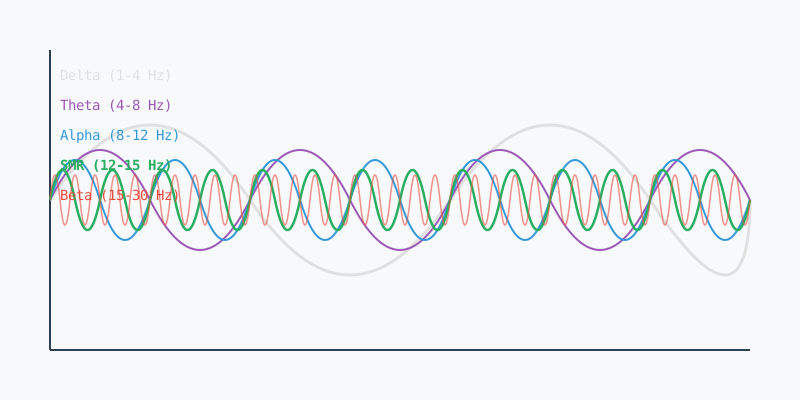
Moving beyond black-box neurofeedback.
For decades, neurofeedback protocols were siloed behind proprietary training systems, expensive seminars, and vendor lock-in. Practitioners were taught which buttons to press on specific software, rather than why specific cortical hubs respond to specific frequency reinforcement.
We believe clinical efficacy requires transparency. This archive standardizes the nomenclature of neuromodulation, providing device-agnostic, parameter-level details for established protocols.
Protocol Archive
Device-agnostic parameter settings for established methodologies, from classical SMR conditioning to Infra-Low Frequency (ILF) and z-score surface training.
View ArchiveCondition Models
Mechanistic breakdowns of how specific neurological dysregulations (ADHD, PTSD, Insomnia) manifest in QEEG phenotypes, and the indicated interventions.
Browse ConditionsPractitioner Directory
A vetted, searchable database of clinical providers, filterable by licensure, BCIA certification, accepted insurance, and specific modality expertise.
Find a ProviderFoundational Protocols
View all 42 protocols →SMR Enhancement
12-15 HzThe classical operant conditioning protocol developed by Sterman. Reinforces the Sensorimotor Rhythm at Cz or C3/C4 to reduce motor excitability.
Alpha-Theta Crossover
4-12 HzA deep-state eyes-closed protocol developed by Peniston and Kulkosky. Trains the user to increase theta amplitude relative to alpha without falling asleep.
For Clinical Providers
The Institute serves as an agnostic reference standard for clinical practice. We do not sell equipment, software licenses, or proprietary training courses.
- Standardized Parameters: Convert proprietary settings (e.g., "Alertness Protocol A") into raw Hz bands and specific 10-20 locations.
- Equipment Comparisons: Unbiased technical specifications of amplifiers, from 2-channel to 19-channel QEEG systems.
- Clinical Directory: List your practice for free to connect with patients seeking verified BCIA-certified providers.
Sample Protocol Specification
| Parameter | Standard Value | Clinical Note |
|---|---|---|
| Active Band | 12.0 - 15.0 Hz (SMR) | Reward threshold > 60% time |
| Inhibit 1 | 4.0 - 7.0 Hz (Theta) | Keep below 20% threshold |
| Inhibit 2 | 22.0 - 30.0 Hz (High Beta) | Monitor for muscle artifact |
| Montage | C4-A2, G: A1 | Referential placement |
Clinical Calculators & Tools
Free, browser-based utilities for session planning and QEEG analysis. No data leaves your machine.
10-20 Mapper
Calculate exact anatomical distances based on head circumference.
Band Adjuster
Individualized peak alpha frequency (iPAF) band calculations.
Z-Score Deviation
Manual verification tool for normative database outputs.
Trend Analyzer
Plot inter-session baseline microvolt changes over time.
Frequently Asked Questions
Is neurofeedback covered by insurance?
Coverage varies drastically. While some CPT codes (e.g., 90901) exist for biofeedback, many insurers consider EEG biofeedback experimental for conditions other than ADHD. Always verify specific coverage codes with your provider.
What is a QEEG (Brain Map)?
A Quantitative EEG measures electrical activity across 19+ points on the scalp and compares it to a normative database (people of the same age/sex). This allows practitioners to target specific dysregulated hubs rather than guessing based on symptoms.
How many sessions are required?
Because neurofeedback relies on neuroplasticity and operant conditioning, it is not a quick fix. Standard protocols typically require 20 to 40 sessions, conducted 2-3 times per week, to achieve permanent consolidation of new neural patterns.